
If you’re here, you’ve probably already started to think about conducting a pricing and packaging survey.
Your first step should always be to get super clear about what exactly you’re trying to get out of the survey. What are the questions you’re trying to answer? What are you going to do with the results? What are your knowns and unknowns? These are the types of questions that will help narrow down the survey methodology you should consider.
Some of the most common specialized methods used in pricing and packaging surveys include:
- Van Westendorp’s Price Sensitivity Meter
- Gabor-Granger Method
- Max-Diff (a.k.a. Maximum Difference Scaling, or Best-Worst Scaling)
- Conjoint Analysis (and its many sub-types)
There are use cases that call for each of these methods, and which you choose will depend on the questions you’re trying to answer and, frankly, your budget. For example, Van Westendorp and Gabor-Granger surveys are far simpler and can be done with smaller sample sizes compared to Max-Diff and Conjoint Analysis. However, Conjoint Analysis is often considered the gold standard for quantitative pricing and packaging surveys and, when done right, the results are absolutely worth the investment.
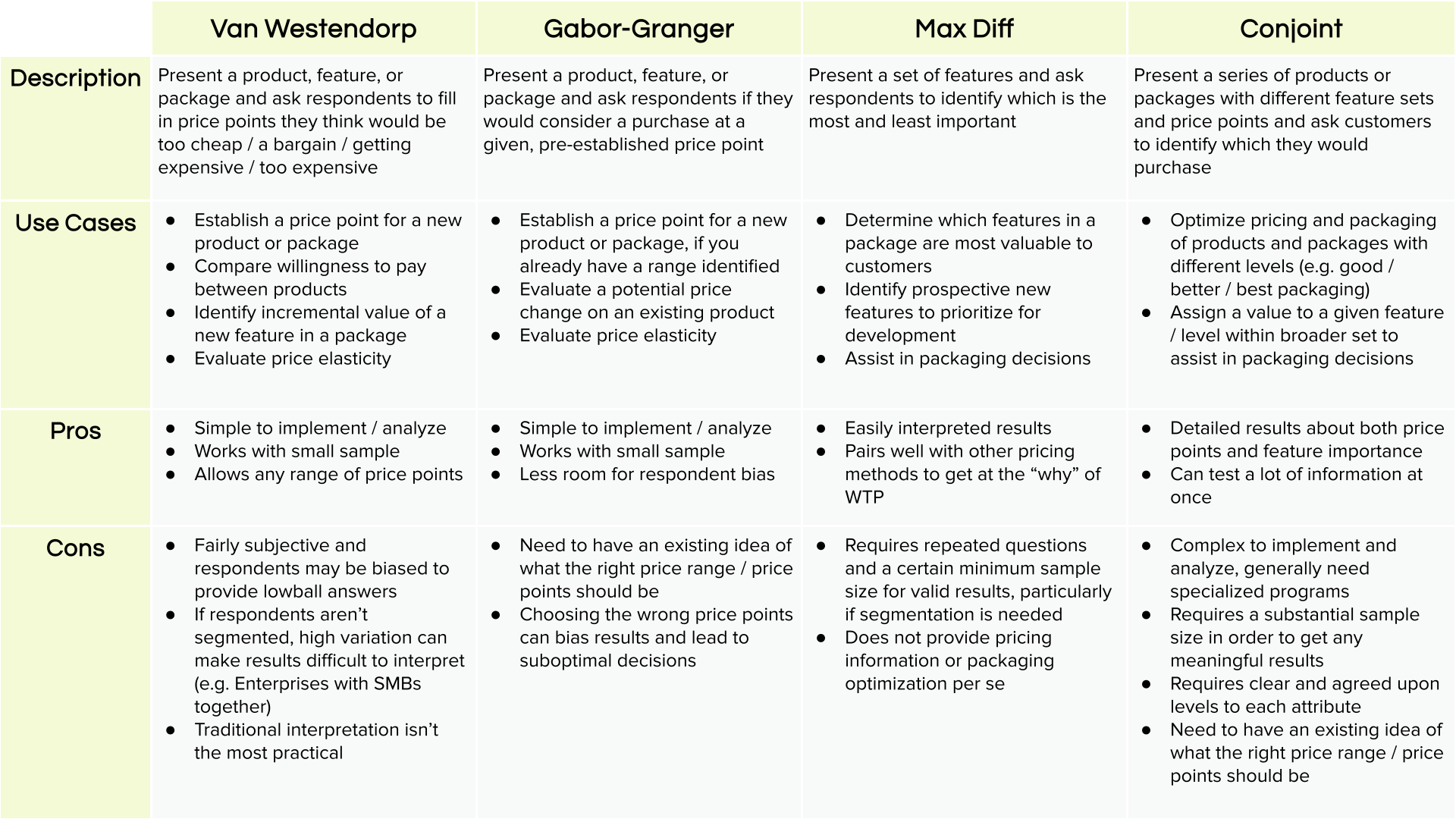
Below is a brief table comparing the methods. Greengage Advisors has deep experience in each of these methods and can help guide you through every step of the process.
 Greengage Advisors
Leave a comment